

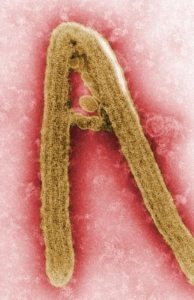
 In the new study that we published in The Journal of Clinical Intervention, UTMB researchers identified a single treatment that provides broad-spectrum protection against Marburg and Ravn viruses, both of which cause deadly disease. Marburg and Ravn viruses cause a disease that’s very similar to the Ebola virus disease. So, it’s a multi-systemic, multi-organ failure, you do have hemorrhagic manifestations. The case fatality rates are very high, just like Ebola. In some of the outbreaks in Central Africa, they’ve been up to 90% case fatality rates. At this point there are no FDA approved therapeutics or vaccines for Marburg or Ravn virus. So doctors typically treat patients that are infected with Marburg or Ravn virus through palliative care. Just like the Ebola patients in Emory where you’d be in a critical care unit and they would be replacing electrolytes and replacing fluids, providing pain relief, that type of thing. Palliative care focuses on making people as comfortable as possible but doesn’t address treating their disease. Because during an outbreak scenario, when you have a patient come to your clinic or to the treatment unit, you’re not quite sure exactly where they are in their disease course. Patients don’t come to a hospital until they’re at a very critical stage of illness. So researchers would not begin treating an animal until it had signs of illness. They want to see how far into the disease course they can intervene and still save the patient. And in these studies they can test where that’s at and know when the therapy is actually going to be efficacious or not. In the study, researchers tested a new potential drug that uses a small interfering RNA against Marburg and Ravn. This is a promising type of therapeutic because they have a good understanding of how it works. The trouble with using small interfering RNA is in developing efficient delivery vehicles that help the body to absorb the medicine. They used a platform called lipid nanoparticles that protects the drug from the body’s defenses and helps it to be delivered to the cells where the virus resides. Non-human primates were lethally infected with Marburg virus and treated with the potential drug. 100% of the animals that received the treatment four days after infection were protected and half of those who got the treatment five days after infection were protected. Along similar lines, non-human primates were lethally infected with Ravn and were treated either three or six days after being infected. All of the treated animals were protected, even when treatment began just one day before the untreated animals became fatally ill. Being able to protect against both Marburg and Ravn is important, since all strains of both viruses circulate throughout the same regions of Africa and have even been identified during the same outbreaks. UTMB researchers’ findings strongly support the further development of this potential drug as a single treatment for both diseases in people. It’s success against the strain of Marburg responsible for the largest and most lethal outbreak in history is a big advance in countermeasure development, especially because the treatment works when given so late in the disease course.
UTMB researchers develop Marburg virus treatment effective five days after infection social media
In the new study that we published in The Journal of Clinical Intervention, UTMB researchers identified a single treatment that provides broad-spectrum protection against Marburg and Ravn viruses, both of which cause deadly disease. Marburg and Ravn viruses cause a disease that’s very similar to the Ebola virus disease. So, it’s a multi-systemic, multi-organ failure, you do have hemorrhagic manifestations. The case fatality rates are very high, just like Ebola. In some of the outbreaks in Central Africa, they’ve been up to 90% case fatality rates. At this point there are no FDA approved therapeutics or vaccines for Marburg or Ravn virus. So doctors typically treat patients that are infected with Marburg or Ravn virus through palliative care. Just like the Ebola patients in Emory where you’d be in a critical care unit and they would be replacing electrolytes and replacing fluids, providing pain relief, that type of thing. Palliative care focuses on making people as comfortable as possible but doesn’t address treating their disease. Because during an outbreak scenario, when you have a patient come to your clinic or to the treatment unit, you’re not quite sure exactly where they are in their disease course. Patients don’t come to a hospital until they’re at a very critical stage of illness. So researchers would not begin treating an animal until it had signs of illness. They want to see how far into the disease course they can intervene and still save the patient. And in these studies they can test where that’s at and know when the therapy is actually going to be efficacious or not. In the study, researchers tested a new potential drug that uses a small interfering RNA against Marburg and Ravn. This is a promising type of therapeutic because they have a good understanding of how it works. The trouble with using small interfering RNA is in developing efficient delivery vehicles that help the body to absorb the medicine. They used a platform called lipid nanoparticles that protects the drug from the body’s defenses and helps it to be delivered to the cells where the virus resides. Non-human primates were lethally infected with Marburg virus and treated with the potential drug. 100% of the animals that received the treatment four days after infection were protected and half of those who got the treatment five days after infection were protected. Along similar lines, non-human primates were lethally infected with Ravn and were treated either three or six days after being infected. All of the treated animals were protected, even when treatment began just one day before the untreated animals became fatally ill. Being able to protect against both Marburg and Ravn is important, since all strains of both viruses circulate throughout the same regions of Africa and have even been identified during the same outbreaks. UTMB researchers’ findings strongly support the further development of this potential drug as a single treatment for both diseases in people. It’s success against the strain of Marburg responsible for the largest and most lethal outbreak in history is a big advance in countermeasure development, especially because the treatment works when given so late in the disease course.